SAID Research
Exploring the foundations of long-context AI, efficient reasoning models, and emergent semantic memory
"The answer IS X. Because I Said so." — At ANY scale.
Research Frontier
Advancing the state-of-the-art in linear attention and memory architectures
"LAM replaces attention. SCA replaces memory"
LAM - Model
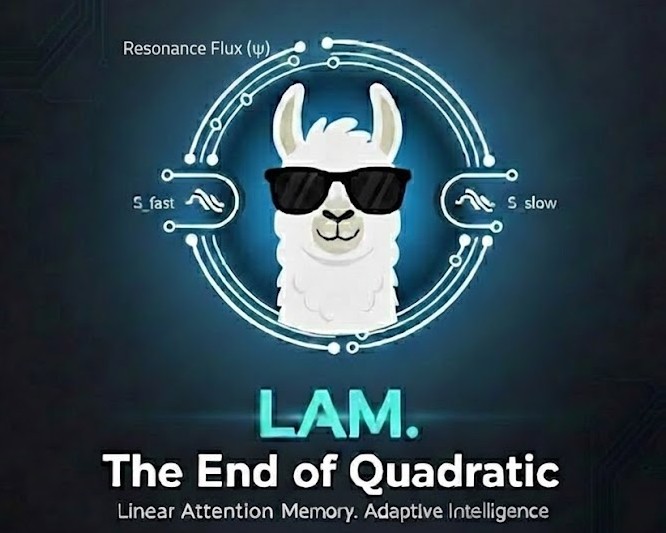
Linear Attention Memory
The first linear attention architecture to achieve state-of-the-art embedding performance—establishing the world's most efficient long-context model.
SCA - Current BETA Release: 32k Deterministic Window | Architecture Capacity: 1B+ Tokens
Experience the zero-drift precision of Crystalline Attention in this initial release.
Now: 32,768 tokens of perfect, deterministic recall (Available Today).
Next: The architecture is proven for 1 Billion+ tokens (Internal Alpha).
The Promise: We are unlocking the door to infinite memory. This 32k Beta is just the first glimpse through the keyhole.
Status
✓ Released & Production Ready

SCA - Memory Architecture
SAID Crystalline Attention
A deterministic attention paradigm that eliminates the "Probabilistic Drift" inherent in standard Transformers
SCA introduces a new class of Linear State Locking: instead of discarding context or relying on probability to "guess" previous tokens, SCA mathematically locks semantic signals into a crystallized, infinite-scale state. This allows the model to maintain signal fidelity whether processing 4k tokens or 1 Billion+ tokens.
Key Properties
Eliminates hallucination in recall tasks by maintaining signal fidelity, regardless of sequence depth.
Utilizes a non-degrading linear update rule, allowing the model's state to expand indefinitely without memory fragmentation.
Architecturally unbounded. Validated in extreme-scale stress tests exceeding 1 Billion tokens with zero precision loss, demonstrating a functional capacity that renders traditional context windows irrelevant.
Functions as a high-dimensional state layer compatible with any embedding system or LLM architecture (including LAM).
Launch Timeline
93% Complete
The SAID Standard (v1.0)
Benchmark & Evaluation
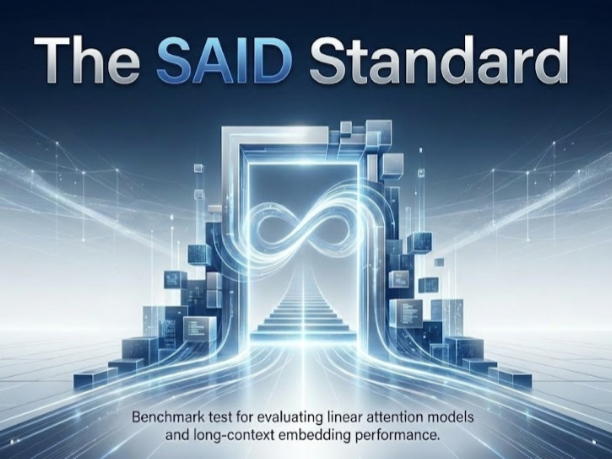
The SAID Standard unifies the industry's most rigorous protocols—InfiniteBench, RULER, Kamradt, and Magic.dev—and scales them to the absolute limit: 1 Billion Tokens.
Launch Timeline
98% Complete

The .said Protocol
Memory as a Service (MaaS)
Current AI memory is architecturally siloed—trapped inside the specific weights of proprietary models or ephemeral context windows. When the session ends, the memory dies. When you switch models, you start from zero.
SAID Research is architecting the .said Protocol—the industrial standard for Portable, Crystalline Memory.
Launch Timeline
15% Complete
The future of AI is not just about processing power. It is about State Portability. The .said Protocol ensures that no matter where you go in the digital world, your memory arrives with you.
LAM — Linear Attention Memory
The first linear attention architecture to achieve state-of-the-art embedding performance—establishing the world's most efficient long-context model
World-First Achievement
• LAM is the first linear attention model to break the 0.80 semantic barrier, achieving 0.8190 Spearman correlation on STS-B.
• It is the world's most efficient long-context model, delivering a 74.96 LongEmbed score (SOTA < 200M) and 100% Recall accuracy at 32k tokens.
• Unlike standard architectures that require specialized nested supervision, LAM exhibits emergent Matryoshka properties without explicit training. The model naturally organizes information by semantic importance within its Orthogonal Memory, allowing for high-fidelity truncation to smaller dimensions (97% retention at 128d)—a capability previously thought to require dedicated Matryoshka training objectives.
With just 31M parameters and 384 dimensions, LAM achieves Transformer-parity performance, competing directly with non-linear models 10x its size while guaranteeing O(n) linear complexity for infinite context scaling.
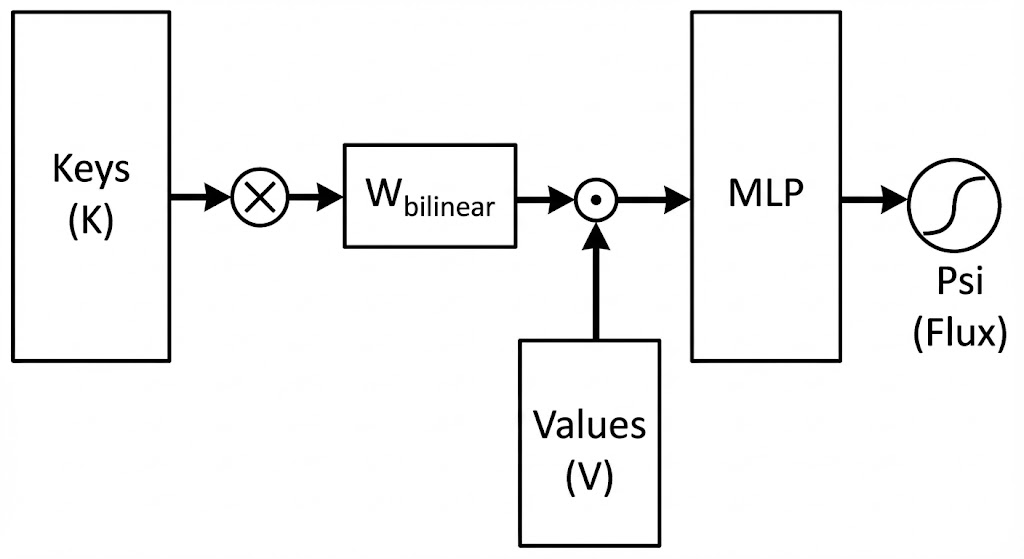
Bilinear Resonance Flux
"The Brain" • (Novelty)
A physics-inspired meta-attention mechanism that dynamically decides what to store based on resonance, rather than static gating.
Emergent Matryoshka Learning
"The Structure" • (Efficiency)
Solves the 2025 inference bottleneck by organizing data hierarchically, allowing elastic deployment without retraining.
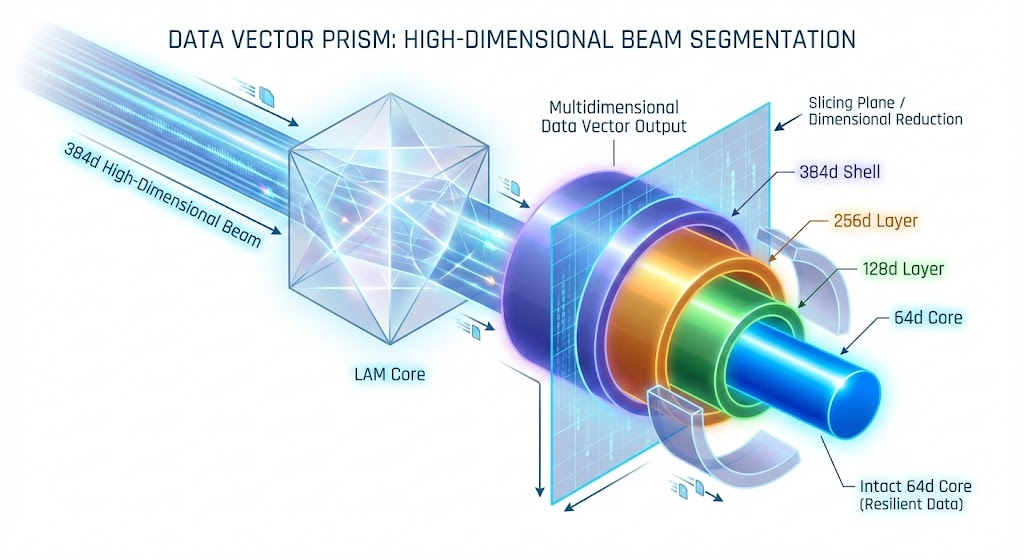
Delta Rule Precision / Decay
"The Heart" • (The Engine)
Combines Error Correction (rewriting incorrect memories) with BIBO Stability (native decay), enabling infinite context without crashing.

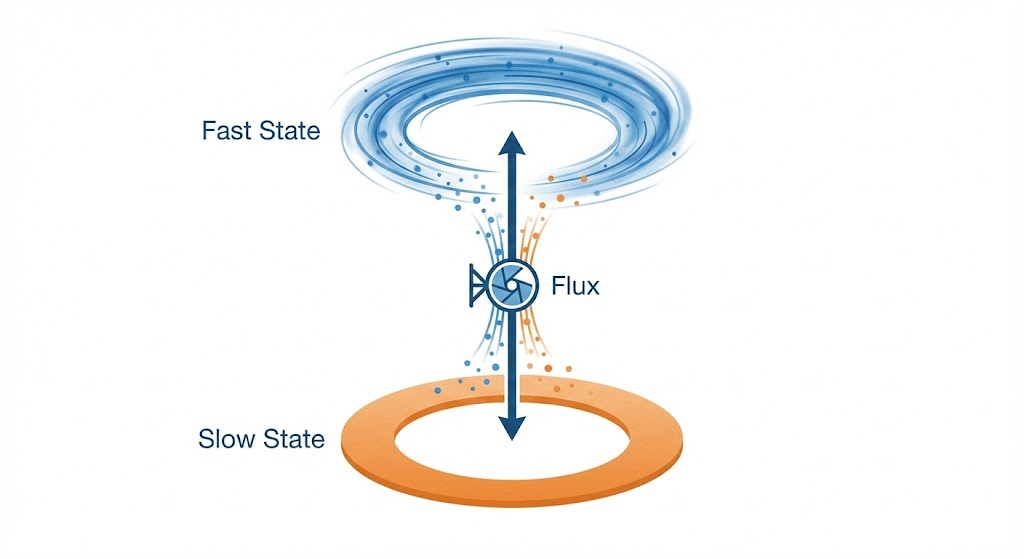
Hierarchical Dual-State Architecture
"The Memory Itself"
Instead of a single flat memory, the model maintains two distinct timelines (Fast/Slow), solving the Plasticity-Stability dilemma.
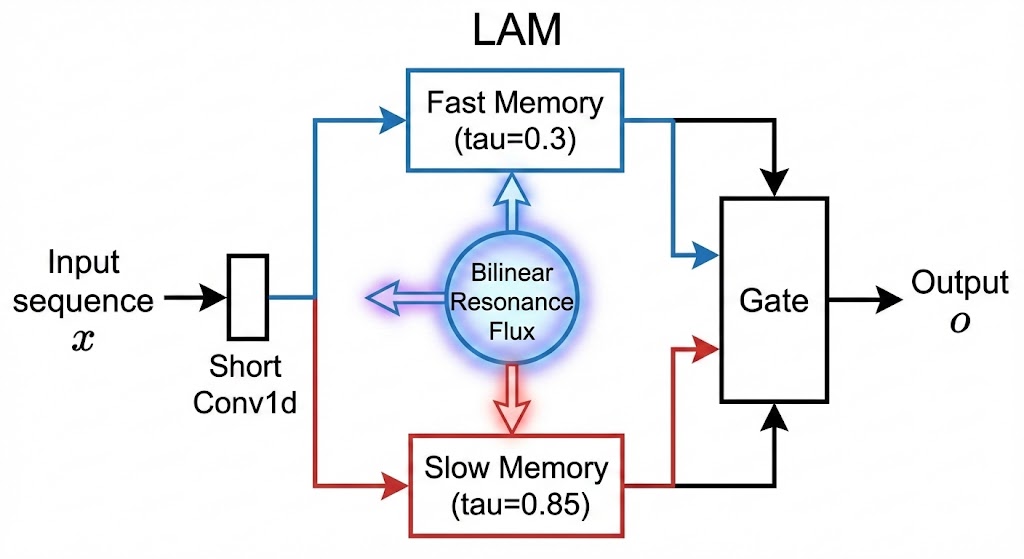
Cross-Timescale Coupling
"The Synapse" • (The Bridge)
A flux-modulated connection that allows the Fast and Slow states to exchange information and consolidate patterns.